Commercial Electricity Providers in Texas: Every REP Compared
There are 139 PUCT-certified retail electric providers in the deregulated ERCOT market. The functional list a commercial buyer should actually shop is shorter. This pillar compares the REP market for businesses, breaks down how commercial contracts are priced, and flags what to ask before you sign.

There are 139 PUCT-certified retail electric provider Texas companies operating in the deregulated ERCOT market. The functional list a commercial buyer should actually shop is shorter, often a dozen or fewer once Option II focus, financial stability, and product fit are filtered. The headline number a REP quotes rarely reflects what your business actually pays. This article compares the retail electric provider Texas market for businesses, breaks down how commercial electricity providers price contracts, and flags what to ask before you sign.
Most "best Texas electricity provider" articles are written for residential customers on a 1,000 kWh-per-month profile. Commercial buyers face a different rate stack, different contract terms, and different risks. This pillar covers the REP market, how commercial REPs are categorized, the five-component rate stack, contract structures, common gotchas, and how to evaluate any retail electric provider Texas businesses are quoted by. For the broader market context including TDU territories and ERCOT mechanics, see the companion pillar on the Texas deregulated electricity market.
How the Texas Retail Electric Provider Market Is Structured
The Texas competitive electricity market and the modern retail electric provider Texas commercial buyers shop today are built on Senate Bill 7, signed by Governor George W. Bush in June 1999. SB 7 restructured the state's electric utility industry and authorized retail competition starting January 1, 2002. The full statutory text is on file with the Texas Legislature. Today, about 85% of Texas load sits inside the deregulated zone.
Three roles split the work that vertically-integrated utilities used to perform alone:
- Generators sell wholesale electricity into the ERCOT market, which clears prices on a 15-minute settlement interval.
- Transmission and Distribution Utilities (TDUs) own the poles, wires, substations, and meters. They are still regulated monopolies. Buyers do not choose them; they are assigned by territory. The six commercial TDUs are Oncor (DFW, North Texas), CenterPoint Energy (Houston metro), AEP Texas North (Abilene, Wichita Falls), AEP Texas Central (Corpus Christi, Rio Grande Valley), Texas-New Mexico Power (scattered), and Sharyland Utilities (parts of West, South, and Central Texas).
- Retail Electric Providers (REPs) are the competitive layer. They buy from the wholesale market and resell to end customers. The PUCT REP directory lists 139 active REPs operating under 160 DBAs (Doing Business As entities) as of 2026.
Excluded from the deregulated zone: municipal utilities (Austin Energy, San Antonio CPS, Garland Power and Light, Bryan Texas Utilities) and most rural electric cooperatives. A handful of cooperatives have opted into competition, but the default in muni and co-op territory is no choice. If your facility sits inside one of those territories, the rest of this article does not apply, the incumbent utility supplies you under a regulated tariff.
PUCT Certification Tiers and What They Mean
PUCT certifies every retail electric provider Texas commercial buyers can sign with under one of three options. This is one of the most useful filters a commercial buyer can apply, and almost no comparison site explains it. Different option codes signal different financial backing and different customer protection.
Option I (Standard REP Certificate). Authorizes service to residential and all commercial classes. Requires $10,000 minimum tangible net worth, a $100,000 surety bond, and customer-protection-fund contributions. Most household-name REPs hold Option I (TXU Energy, Reliant Energy, Direct Energy). It is the broadest license but the lowest financial bar.
Option II (Enhanced REP Certificate). Restricted to non-residential customers. Requires $100,000 minimum net worth and a $250,000 bond. An Option II REP is, by design, a commercial-or-industrial-only operator. The certification itself is a signal that the REP serves businesses as its primary line of work. Calpine Energy Solutions and Shell Energy hold Option II for their Texas commercial books.
Option III (Aggregator). Does not supply power. Used by aggregators and brokers that do not take title to electricity. Minimum $3,000 net worth.
The buyer's takeaway: Option II plus a financially-strong parent (S&P investment grade) is the strongest commercial-only signal. Option I with a major parent (NRG, Vistra, Constellation) is the next tier. Verify any REP's option and certification number through the PUCT REP search. Certification rules are in PUCT Substantive Rule §25.107.
The Major Commercial Electricity Providers in Texas
The 139 PUCT-certified retail electric provider Texas brands sort into a few coherent categories for commercial buyers. Ranked lists by market share are misleading because the right REP depends on territory, load size, and credit profile. Below is the categorical map.
NRG Energy Portfolio
NRG owns the second-largest cluster of Texas REP brands, with several distinct commercial product positions. As of late 2025, Vistra announced an intent to acquire the NRG retail portfolio for approximately $2.8 billion. The deal was filed with PUCT in November 2025 and is pending approval; if approved, the combined entity would represent roughly 40% of ERCOT mass-market load.
- Reliant Energy is the NRG flagship commercial brand, with strong presence in Houston and Dallas. Reliant focuses on small-to-mid C&I (roughly 500 kW to 5 MW) with bill-credit and rewards-style commercial programs.
- Direct Energy was acquired by NRG in 2021. Direct targets the small-business segment under 100 kW up to mid-C&I around 10 MW, and bundles efficiency tools.
- Cirro Energy is NRG's value-tier commercial brand, focused on small businesses under 500 kW.
- Green Mountain Energy is NRG's 100% renewable brand, REC-backed, often used by commercial customers buying renewable energy for sustainability reporting.
Vistra Corp Portfolio
- TXU Energy is the largest Texas REP by customer count, around 1.7 million accounts statewide. TXU serves the full small-mid-large C&I range and is a common default for businesses operating across multiple TDU territories. TXU is also the primary Provider of Last Resort in the Oncor zone.
Generation-Owned REPs (Large Industrial Focus)
These REPs typically prefer customers above 5 MW and offer custom hedges, PPAs, and behind-the-meter integration.
- Calpine Energy Solutions (Houston-based; Calpine owns roughly 6 GW of Texas gas generation) targets large industrial loads and increasingly hyperscale data centers.
- Constellation Energy (formerly part of Exelon) is nationwide with a strong large-C&I book in Texas. Custom PPAs, demand response programs, 100% renewable options.
- Shell Energy acquired the MP2 Energy book and serves large C&I, hedging-heavy. As of 2025, Shell is offering BTM solar plus battery storage packages for data centers.
- Engie Resources (part of Engie SA) targets mid-to-large C&I with a sustainability and EV-charging-integration focus.
Mid-Tier Commercial REPs
- Champion Energy Services offers aggressive small-mid C&I pricing.
- APG&E (PUCT certification 10105), Houston-based, focuses on mid-market commercial.
- Hudson Energy (Just Energy book) targets small-medium commercial with active marketing.
- Spark Energy (formerly Stream) operates multi-site small-mid C&I programs through an app-based management interface.
New 2024-2026 Entrants (Clean Energy and VPP)
- Octopus Energy entered Texas in Q3 2024 as a virtual-power-plant aggregator, participating in ERCOT ancillary services.
- Tesla Energy received PUCT approval in Q4 2025 for VPP-linked commercial tariffs using Megapack and the Autobidder optimization platform.
- CleanChoice Energy entered Q2 2026 with REC-backed commercial PPAs.
- Pulse Power offers demand-response programs paying commercial customers $50 to $100 per kW for committed curtailment.
A representative sample of additional active retail electric provider Texas commercial brands includes Gexa Energy (a NextEra subsidiary), AmeriPower Energy, Pioneer Energy, Heritage Power, Penstar Power, Pogo Energy, Power Express, Texans Energy, 4Change Energy, Frontier Utilities, and Chariot Energy.
The Five-Component Texas Commercial Rate Stack
Every commercial bill in the deregulated zone breaks into five components. If a quote does not separate all five, the buyer is comparing partial pictures. The Five-Component framework is the analyst lens to use on every retail electric provider Texas businesses might present.
- Energy Supply. The REP's component, market-driven, usually quoted in cents per kWh. Term length, load size, and credit profile move it. The 2026 range on competitive 12-month commercial fixed contracts is roughly 5.5 to 9.5 cents per kWh.
- TDU Delivery. Set by the regulated tariff for the customer's territory. Non-bypassable. Typical 2026 range is 1.5 to 3.5 cents per kWh, with Houston (CenterPoint) running about a half-cent higher than DFW (Oncor). PUCT Docket 50914 approved a 3.2% Oncor commercial-rate increase for 2026; CenterPoint Docket 51234 includes $1.2 billion in grid-hardening investment passed through to customers.
- Ancillary Services. Set by ERCOT to keep the grid balanced (frequency regulation, spinning and non-spinning reserves, ECRS contingency reserve). Typical 2026 range is 0.5 to 1.5 cents per kWh, and rising as reserve margins tighten.
- Capacity and Demand Charges. Apply to demand-metered accounts. The driver is the ERCOT 4 Coincident Peak (4CP) program, which identifies the single highest 15-minute grid-wide demand interval in each of June, July, August, and September. A facility's load during those four intervals sets its transmission demand charge for the entire next year. Average commercial demand charges run around $40 per kW per month and account for 30% to 70% of a typical commercial bill.
- Regulatory Fees. PUCT-mandated charges, including the Retail Renewable Portfolio Payment, nuclear-decommissioning rider, and similar pass-throughs. Small in dollars (roughly 0.02 to 0.04 cents per kWh) but always present.
Worked example: a 6.5-cent "energy-only" quote in Oncor territory for a demand-metered commercial account becomes about 9.5 cents all-in once delivery (~3.0), ancillary (~0.7), and demand and regulatory components are added. Brokers commonly quote the energy piece to look competitive; the all-in number is what hits the bill.
Commercial Contract Structures Compared
Five contract structures dominate the retail electric provider Texas commercial market. The right structure depends on load profile, risk tolerance, and credit position.
Fixed-rate. A locked cents-per-kWh price for 12, 24, 36, 48, or 60 months. Predictable, with early-termination fees on early exit. Best for steady-load operations. Term-rate tradeoffs based on April 2026 reference quotes:
| Term | Approximate energy-only delta vs. 12-month |
|---|---|
| 12 months | baseline |
| 24 months | -0.1 cents per kWh |
| 36 months | -0.2 cents per kWh |
| 48-60 months | -0.3 cents per kWh |
Longer terms typically come with lower energy rates (REPs amortize hedge premiums and fixed credit costs over more volume), at the cost of less flexibility if your load drops or solar/storage is installed.
Variable or month-to-month. Tracks wholesale and serves as the default after a fixed plan expires. Useful only as a bridge while shopping a new contract.
Indexed plans. Three distinct shapes that competitor sites often blur together.
- Heat-rate contracts price energy as
($/MMBtu of natural gas) × heat rate. Example: gas at $4 per MMBtu times a 7.5 heat rate equals 3.0 cents per kWh of energy. Used for gas-tied industrials. The exposure is to natural-gas volatility; a $2 spike in gas adds 1.5 cents to your energy line. - Block-and-index mixes a fixed block and an indexed block. Example: first 80,000 kWh per month at a fixed 4.5 cents, anything above settled to ERCOT's day-ahead hub price plus a markup. A 100,000 kWh month settles at (80,000 × 4.5) + (20,000 × 5.5 index) = $5,000.
- Layered hedge blends fixed energy with options and spot in tranches the REP procures sequentially. The customer pays a hedge premium of roughly 0.2 cents per kWh for the smoothing. Layered structures averaged 12% savings versus pure spot during the 2025 ERCOT heatwave.
Time-of-use plans. Different rates by peak and off-peak periods. Worth modeling for cold storage, manufacturing with night shifts, and any commercial customer that can shift load to nights or weekends.
Swing-tolerance / take-or-pay structures. Custom for large customers above 5 MW. Define usage bands or minimum take volumes. The contract penalizes deviation from the band.
Six Commercial Contract Gotchas
These are the contract terms that most often surprise commercial buyers after signing. Every one is fixable in negotiation.
1. Liquidated damages on early termination
Most commercial contracts price early termination as liquidated damages, not a flat fee. The standard formula:
LD = max(0, [Market Price - Contract Price] × Remaining MWh) + fixed administrative fee
Worked example. A 24-month contract at 5.0 cents per kWh, 12 months left, 1,200 MWh remaining. If the spot market is at 8.0 cents:
LD = max(0, [0.080 - 0.050] × 1,200,000 kWh) = $36,000, plus a typical $5,000 administrative fee = $41,000 in early termination cost.
PUCT Substantive Rule §25.461(f) governs reasonableness of these clauses. Negotiate flat-fee ETF caps where possible. Where the LD formula is unavoidable, demand language clarifying that the "market price" is set against a published index (ERCOT day-ahead hub) and not the REP's discretion.
2. Evergreen renewals at REP discretion
Many contracts auto-renew unless the customer gives 60 to 90 days written notice. The renewal language usually reads: "Service will continue at then-current market rates determined by [REP]." Translation: the REP picks the new rate, often 10-25% above the prior one. Insist on either no auto-renewal, a fixed renewal cap, or notice no later than 30 days from contract start.
3. Bandwidth and swing-tolerance settlement math
A 90-110% bandwidth on 100,000 kWh per month means anything between 90,000 and 110,000 kWh settles at the contract rate. Outside the band:
- Excess at 115,000 kWh: the first 110,000 settle at 5.0 cents = $5,500. The 5,000 kWh above the band settle at the higher of contract or wholesale. If wholesale is 7.0 cents, that 5,000 kWh costs $350 instead of $250. Total bill: $5,850 versus $5,750 if the band were 120%.
- Deficit at 85,000 kWh: 85,000 settle at the contract 5.0 cents = $4,250. The 5,000 kWh shortfall is bought back by the REP at index (7.0 cents) and billed to the customer at $350. The customer pays for power they did not use. Total: $4,600.
The deficit case is the one that surprises operators whose load drops mid-contract, often from a recession, equipment downtime, or a solar install. Negotiate wider bands (80-120%) for seasonal or variable-load businesses.
4. Power factor and kVAR penalties
Power factor measures how efficiently a facility uses electricity. A power factor below 95% triggers TDU penalties under PUCT Rule §25.481, which the REP passes through. An Oncor commercial customer with 85% power factor on 100 kW of demand pays roughly $500 per month in penalty charges, around $6,000 per year. Some REPs bundle a power-factor assumption into all-in pricing (Infinite Energy's 8.2-cent product assumes 95%); others bill separately. Industrial customers with large motor loads should price both versions.
5. Mismatched contract end dates with TDU annual reset
TDU rates change every June 1 under PUCT Rule §25.451. If a REP contract ends in March or April, the customer rolls onto a month-to-month variable plan that absorbs the June rate change. Align contract end dates with the TDU reset (May 31 expiration is the cleanest exit) or build the bridge cost into the renewal model.
6. Ancillary-services pass-through and ECRS adders
Following the launch of ECRS (Operating Reserve Capacity Reliability Scarcity) in Q4 2025 under PUCT Rule 25.505, several REPs added scarcity-adder pass-throughs to commercial contracts. Unhedged loads can see $0.10 per kWh or more during scarcity events. ERCOT's ORDC update under Market Notice 123456 (November 2025) widened the adder bands to a 900-2,400 MW range, exposing pure-spot or shallow-hedge loads to $5,000-$9,000 per MWh prices during reserve-shortage hours. Hedged plans now offer ECRS rebates of $20-$50 per MW-day to offset.

Brokers vs. Going Direct to a Retail Electric Provider
Most commercial buyers above $2,500 per month in electricity cost work through a broker. Most do not realize how the broker is paid.
A broker is an intermediary. The broker does not supply energy. They compare plans across a network of REP partners (typically 20 to 50, not the full 139), negotiate, and handle enrollment paperwork. The buyer pays nothing directly. The REP pays the broker a commission, structured almost universally as a 0.1 to 0.5 cent per kWh markup baked into the contract rate. On a 1 million kWh per year load at 0.3 cents, the broker's commission is $3,000 per year, embedded in the rate the buyer signs.
This compensation model creates a structural conflict. Brokers have an incentive to favor REPs paying higher commissions. They are not required to show the buyer the full 139-REP universe, only the partners they have agreements with.
Texas requires broker registration with PUCT under Project No. 49947, effective September 1, 2019. Registration costs $550 initially and $330 annually, requires a designated responsible party background check, and obligates the broker to disclose affiliations and maintain errors-and-omissions insurance. More than 1,300 brokers were registered as of early 2026. REPs are prohibited from contracting with unregistered brokers.
Major Texas commercial brokers commonly seen in RFPs include APPI Energy, Tradition Energy, Schneider Electric Energy and Sustainability Services, 5 (Digital Energy by 5), and Constellation NewEnergy.
When direct shopping makes sense:
- Annual electricity cost under $30,000: use a comparison platform or shop two or three REP websites directly.
- Annual cost $30,000 to $250,000: use a broker, but request commission disclosure in writing as part of the engagement.
- Above $250,000: dual-track. Run a direct RFP to three or four large REPs (Reliant, TXU, Constellation, Calpine, Shell) in parallel with one broker. Compare both stacks.
Buyers who want a sounding board on a specific quote can contact the TxCP team for an independent read.
Provider of Last Resort (POLR): Your Safety Net
If a retail electric provider Texas commercial customers are signed with exits the market or fails financially (Just Energy filed Chapter 11 in March 2021 after $300 million in Winter Storm Uri losses), the affected commercial customers are not cut off. They are transferred automatically to the Provider of Last Resort designated for their TDU zone.
The current POLR designations under PUCT Project No. 51372 run from January 1, 2025 through December 31, 2027:
| TDU Zone | Primary Commercial POLR | Secondary | Sample 2026 energy rate | Demand charge |
|---|---|---|---|---|
| Oncor (DFW, North Texas) | TXU Energy | Reliant Energy | 9.5-12.0 ¢/kWh | $10.50/kW |
| CenterPoint (Houston) | Reliant Energy | Direct Energy | 10.0-13.0 ¢/kWh | $11.00/kW |
| AEP Texas | Reliant Energy | TXU Energy | 9.0-12.5 ¢/kWh | $10.00/kW |
POLR rates include a fuel-factor adder updated quarterly. The Q1 2026 fuel factor is approximately 3.5 cents per kWh, up from 2025 levels because of natural-gas volatility. Net effect: POLR rates run 20-50% above competitive market plans by design. The system is meant to be a safety net, not a destination.
If your REP exits or fails, treat POLR as a 30-day window to re-shop, not a place to sit. The most expensive option a commercial customer can take is to ride POLR pricing for a full billing cycle while the procurement team evaluates new quotes.
Retail Electric Provider Selection: The TxCP 4-Pillar Scorecard
The right retail electric provider Texas businesses should choose depends on the buyer's territory, load shape, and credit profile. Rather than ranking REPs in the abstract, evaluate any prospective REP across four pillars on a 1-10 scale.
1. Financial Stability (weight: 25%). S&P credit rating of the parent company. Years of Texas operation. PUCT certification option (Option II is a stronger commercial signal than Option I). Customer-protection-fund participation. Post-Winter-Storm-Uri exposure history. NRG, Vistra, Constellation, and Calpine all hold investment-grade ratings; some smaller REPs are unrated and carry higher counterparty risk on long-dated contracts.
2. Product Fit (weight: 25%). Does the REP offer the contract structures your load shape requires? Indexed availability for industrials? VPP and demand response participation? Renewable PPAs or REC-backed green tariffs? An REP with only 12-24 month fixed plans is a poor fit for a 10 MW industrial load that needs custom hedging.
3. Contract Flexibility (weight: 25%). Flat-fee versus liquidated-damages ETF. Bandwidth size. Power-factor terms (bundled versus pass-through). Termination notice requirements. Renewal language (auto-renewal at REP discretion versus capped or fixed-renewal). Smaller REPs sometimes negotiate more aggressively on these terms than the household names.
4. Service Track Record (weight: 25%). PUCT complaint ratio per 1,000 customers. BBB rating. Account-management depth (does the REP assign a dedicated rep to >1 MW accounts, or push everything to a call center?). Response time on billing disputes. The PUCT consumer dashboard publishes complaint statistics.
The scorecard total is out of 40. A score above 32 is a credible long-list candidate. Below 24, the buyer should look elsewhere unless the rate is extraordinary.
Five Questions to Ask Every REP or Broker
Use these verbatim in any commercial RFP or quote review.
- What is the exact pricing formula, and which components pass through? A good answer separates Energy, TDU Delivery, Ancillary Services, Capacity and Demand, and Regulatory Fees. A bad answer shows only one all-in number.
- What are all fees: ETF formula, late, imbalance, swing, deposit, and credit requirements? A good answer hands you a fee schedule. A bad answer says "standard."
- How does the contract handle usage variance, peak demand changes, and ERCOT scarcity events? A good answer references specific bandwidth, demand-true-up windows, and scarcity-adder pass-through language. A bad answer is generic reassurance.
- What is your renewal mechanism, and is there an evergreen clause? A good answer specifies the notice window, the renewal rate basis, and how the customer can opt out. A bad answer says "we will send you a notice."
- (For brokers) How is your compensation structured per kWh, and will you share every offer received? A good answer discloses the markup in cents per kWh and produces every quote including REPs they did not select. A bad answer redirects to "we work for you."
2026 Market Shifts Affecting Retail Electric Provider Choice
Several structural changes in late 2025 and 2026 are reshaping the Texas commercial REP market.
The pending Vistra-NRG retail merger, filed with PUCT in November 2025, would consolidate roughly 40% of ERCOT mass-market load under one parent if approved. PUCT analysis suggests post-merger commercial rates could rise 5-10% during integration. Commercial buyers should run pricing from at least one non-Vistra-non-NRG alternative (Constellation, Calpine, Engie, Shell) on every renewal until the deal clears.
Senate Bill 6 (2025) mandates 10 GW of new dispatchable thermal generation by 2028. The funding mechanism passes through REP hedging costs, which PUCT analysis estimates will raise commercial fixed rates 8-12% over the next 24 months.
ECRS launched in Q4 2025 under PUCT Rule 25.505. The framework pays REPs for maintaining reserves during scarcity. Commercial customers see two-sided exposure: scarcity adders on unhedged loads, ECRS rebates on hedged plans.
Real-Time Co-Optimization (RTO) went live in Q2 2026 after a Q3 2025 test phase. ERCOT estimates RTO reduces REP imbalance costs 15-20%. Some of that savings flows to customers as lower energy rates over the next contract cycle.
Data center and AI load growth added approximately 15 GW to ERCOT's interconnection queue by 2026 per EIA January 2026 data. ERCOT load grew 5.5% in 2025 alone. Several major REPs began rationing new commercial connections in late 2025: Vistra and TXU paused new commercial sign-ups under 50 MW in Q4 2025. Mid-market commercial buyers in tight TDU zones (CenterPoint, Oncor) may need to start the procurement process 180 days before contract expiration rather than the conventional 90.
Frequently Asked Questions
How many retail electric provider Texas businesses operate in 2026?
The PUCT directory lists 139 active REPs operating under 160 DBAs as of 2026. About 95 hold Option I (residential plus commercial) certification, 44 hold Option II (commercial and industrial only), and 2 hold Option III (aggregator). The full directory is at puc.texas.gov.
What is the difference between a REP and a TDU?
A REP (Retail Electric Provider) is the competitive layer: it buys wholesale electricity, sets retail prices, signs contracts with end customers, and handles billing. A TDU (Transmission and Distribution Utility) owns the wires, poles, and meters and delivers power physically. TDUs are regulated monopolies; customers do not choose them. REPs compete; customers choose. Every commercial bill in deregulated Texas is the sum of REP charges and TDU charges.
What does Option I, II, and III mean on a REP's PUCT certification?
Option I authorizes service to residential and commercial customers; the financial bar is $10,000 net worth and a $100,000 surety bond. Option II is restricted to non-residential customers and requires $100,000 net worth and a $250,000 bond. An Option II REP focuses on businesses by design. Option III is for aggregators and brokers that do not take title to electricity; the minimum is $3,000 net worth.
Who is my REP's Provider of Last Resort if they go out of business?
Under PUCT Project 51372, the primary commercial POLR by zone is: TXU Energy in Oncor; Reliant Energy in CenterPoint and AEP Texas. Secondary POLRs are Reliant in Oncor; Direct Energy in CenterPoint; TXU in AEP Texas. POLR rates run 20-50% above competitive market and include a quarterly fuel-factor adder (Q1 2026 was approximately 3.5 cents per kWh). Re-shop within 30 days of any POLR transfer.
Are commercial electricity rates the same across REPs?
No. A representative 12-month commercial fixed-rate quote in Oncor territory in April 2026 ranged from 5.5 to 9.5 cents per kWh on the energy line alone, before TDU delivery, ancillary services, demand, and regulatory components are added. Spreads of 1.5 to 2.0 cents per kWh between the cheapest and most expensive REP for the same customer profile are common. The right rate depends on credit, term, load factor, bandwidth, and power-factor terms, not just the headline number.
What is the average length of a Texas commercial electricity contract?
The most common commercial term is 24 months, followed by 12 and 36 months. Longer terms (48 to 60 months) carry the lowest rates per kWh but the largest rate-regret risk if the market drops. Most Texas commercial customers should not lock past 36 months unless they have a specific hedging objective beyond price stability.
Do brokers cost extra on top of the REP's rate?
The buyer pays no direct fee to a Texas energy broker. The REP pays the broker a commission, typically 0.1 to 0.5 cents per kWh, embedded in the contract rate. Your contract rate is the rate plus the broker's commission. On a $50,000 annual electricity bill, a broker's commission at 0.3 cents per kWh on a 1 million kWh load is roughly $3,000 per year. Always ask the broker to disclose the commission rate in writing.
For a snapshot of current commercial offers across Texas REPs, see the current commercial plan data tracked by Texas Commercial Plans. For the methodology behind apples-to-apples REP comparison, see how electricity rate comparison works in the Texas ERCOT market. For the broader market context, the companion pillar covers the Texas deregulated electricity market at the system level.
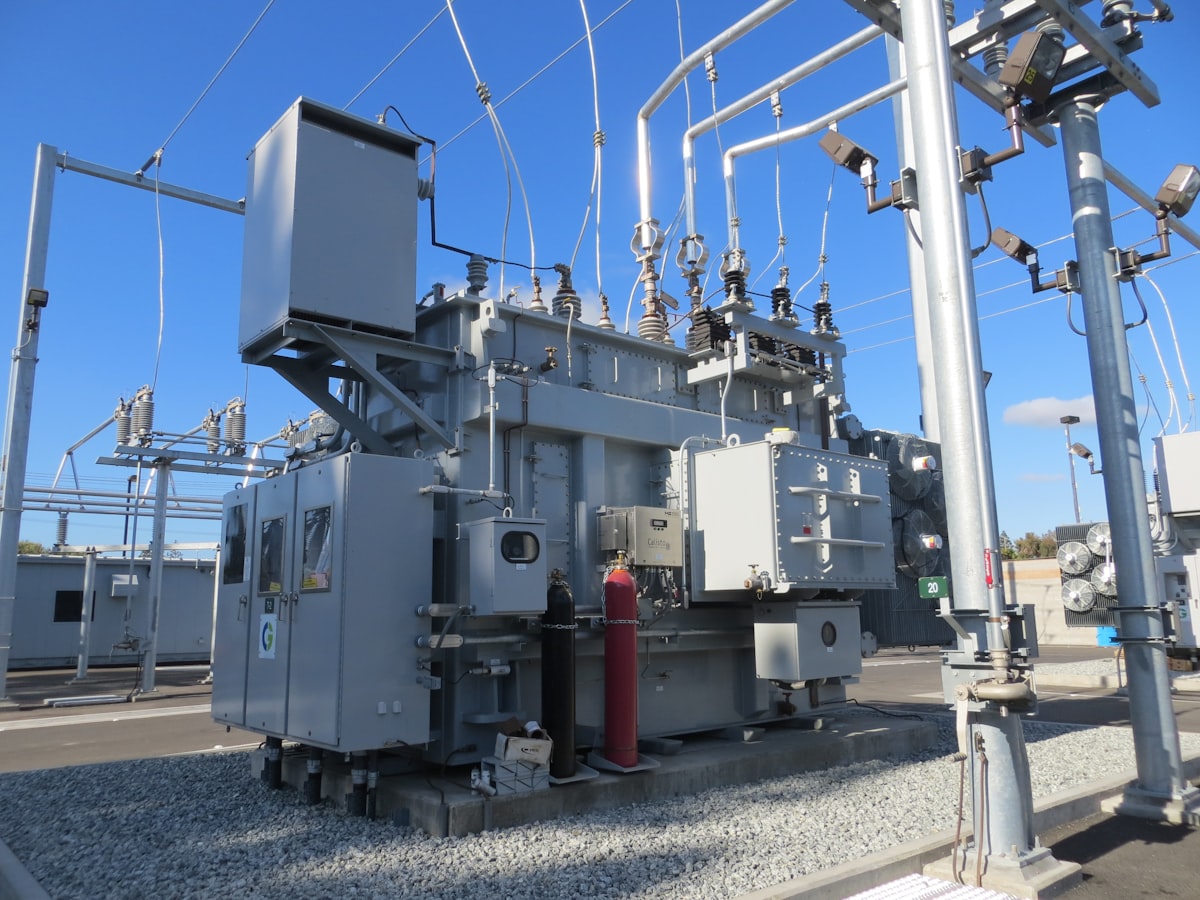
Hero photo by Max Fray on Unsplash. Substation photo by American Public Power Association on Unsplash. Warehouse photo by Sierra Bell on Unsplash.